Spectral WaveFront Review (2026): An Honest Assessment
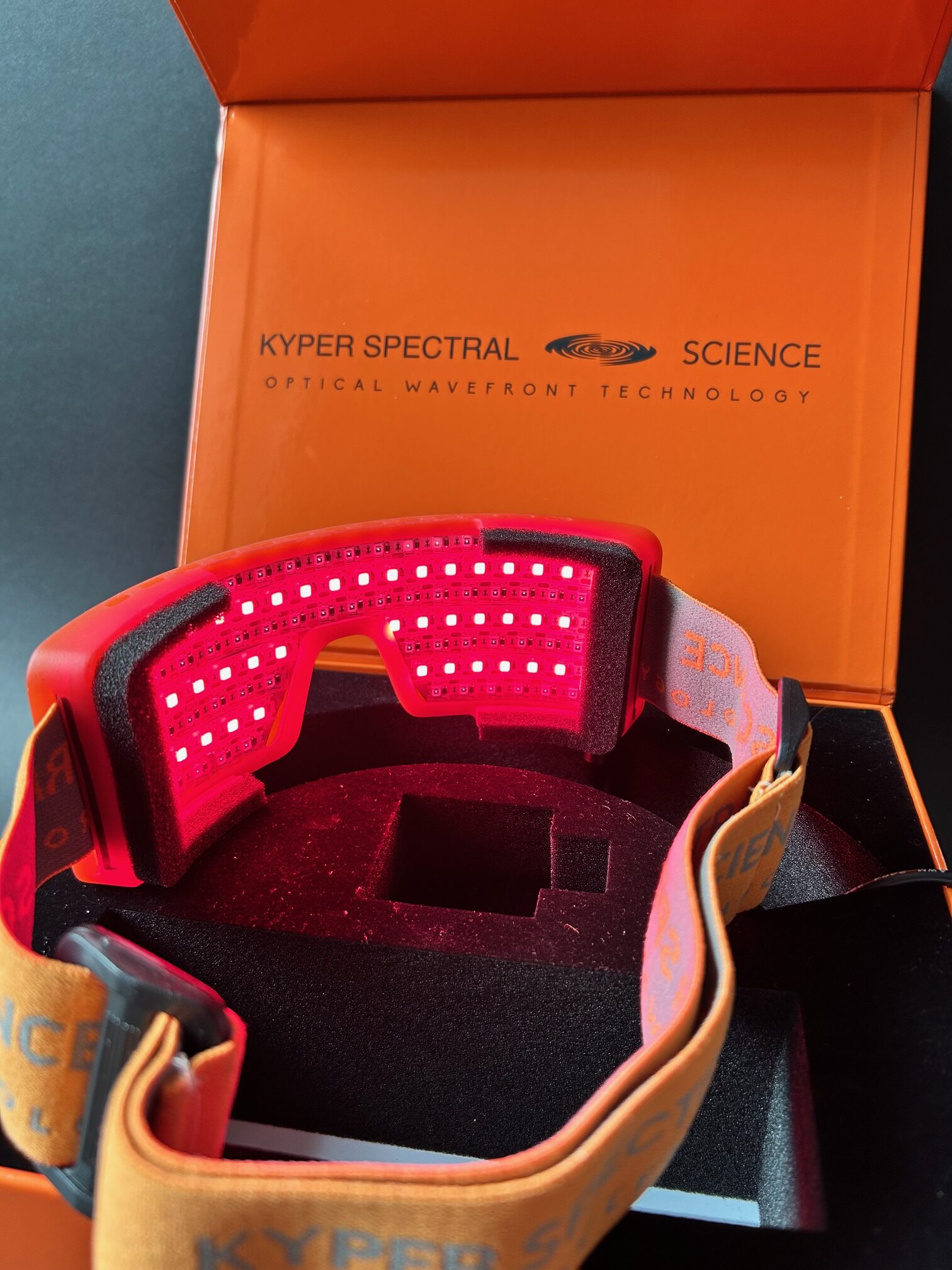
The Spectral WaveFront is one of the most capable at-home red light eye masks you can buy, and also one of the hardest to assess honestly, because its maker maps it to strong published science without having run a trial on the device itself. That gap is the whole story of this review. We grade the WaveFront Promising: the wavelengths it delivers are backed by real research, the engineering is genuinely ambitious, but the evidence is borrowed from studies of the same light, not from this mask.
This is an independent assessment. We score the WaveFront on the same criteria we apply to every device in our eye-device buying guide, and we sell no hardware. If you want the short version: it is a strong choice for someone who wants dual-wavelength, dry-eye, and retinal-support modes in one mask and understands they are buying a wellness device, not an FDA-authorized treatment.
The Institute sells no hardware. The product photo belongs to the manufacturer and is shown for identification; it would be licensed or credited before any public launch.
Our verdict at a glance
Promising A capable dual-wavelength mask whose evidence is mapped to its wavelengths, not to its own clinical trial.
What the Spectral WaveFront is
The Spectral WaveFront, made by Kyper Spectral Science, is a full-face at-home mask that aims light at the eyes and eyelids rather than the surrounding skin. That places it firmly in the eye-health category rather than the cosmetic one: it is built to support the ocular surface, the oil glands in the lids, and the retina, not to smooth crow’s feet.
It is positioned as a single device that covers several use cases that normally require separate products. It delivers two wavelengths at once, offers distinct modes for the macula and for dry eye, and adds gentle lid warmth. For someone weighing a clinic course against a home device, that breadth is the main draw, and it is why the WaveFront sits at the premium end of the at-home market at around $289.
How it works
The WaveFront delivers 670nm red and 810nm near-infrared light, the two wavelengths most studied for ocular tissue. Red light around 670nm is the wavelength researchers have used in retinal work, while near-infrared around 810nm penetrates deeper tissue, and a review of ocular photobiomodulation identifies both as the ranges most examined for the eye (Gaspari et al., 2024).
On top of the light, the mask adds gentle warmth near 39°C. The rationale is mechanical rather than photobiological: warming the eyelids helps soften and loosen the oils in the meibomian glands, which is the same principle behind the warm compresses eye doctors recommend for blocked glands. Combining light and heat in one device is part of what justifies the price.
The dose is fixed by the mask’s preset modes and session timers, which run 16 to 21 minutes. That matters because light therapy follows a biphasic curve where more is not better, and a controlled, capped dose is safer than an open-ended one (Huang et al., Dose-Response 2009).
The evidence: what is actually supported
This is where an honest review has to slow down. The WaveFront’s wavelengths are well supported; the WaveFront itself has not been the subject of its own published trial. Those are two different claims, and the marketing around any device in this category tends to blur them.
For the macular and retinal-support mode, the strongest relevant evidence is University College London work in which a single 670nm exposure improved colour-contrast sensitivity by up to 20% in older eyes (Shinhmar et al., Scientific Reports 2021). That study used 670nm light, the same wavelength the WaveFront emits, but it used a research light source, not this mask.
For age-related macular degeneration, the deepest clinical evidence belongs to a different, clinic-based system. The LIGHTSITE III trial of the Valeda Light Delivery System reported improved visual acuity in dry AMD (Boyer et al., 2024). Valeda is the only photobiomodulation eye device with FDA authorization for dry AMD, and the WaveFront is not that device, so its AMD relevance is mechanistic and wavelength-based rather than trial-proven.
For dry eye and meibomian gland dysfunction, device-specific studies do exist, but they tested other manufacturers’ masks: a prospective study of home low-level light therapy reported gains in dry-eye symptoms, tear break-up time, and tear volume (Giannaccare et al., 2022). The WaveFront operates on the same principle, but it has not been run through an equivalent trial under its own name.
The honest bottom line on evidence is that the WaveFront is a well-designed delivery system for wavelengths and a dose that research supports, sold without its own clinical study. That is common in the at-home category, and it is the single most important thing to understand before buying.
Pros and cons
Pros
- Dual 670nm and 810nm wavelengths in one mask
- Separate macular and dry-eye modes plus lid warming
- Capped, preset dose reduces the risk of overuse
- One-time cost with no subscription
- Aims light at the eye, not just the surrounding skin
Cons
- No published clinical trial of the device itself
- Wellness device, not FDA-authorized for any condition
- Premium price for an unproven-as-a-device product
- Evidence is mapped from studies that used other light sources
- Not a cosmetic skincare device
Who it is for, and who should skip it
The WaveFront suits someone who wants broad at-home coverage in a single mask, understands the difference between wavelength evidence and device evidence, and is comfortable buying a wellness product rather than a regulated treatment. If your main goal is dry-eye relief, blocked-gland support, or general retinal aging, and you have realistic expectations, it is a reasonable choice.
You should skip it if you want a device with its own clinical trial, in which case a clinic-based system assessed under medical supervision is a better fit, or if your goal is cosmetic, in which case a wrinkle-focused mask from our eye-mask guide is the right category. Anyone with a diagnosed eye disease should treat the WaveFront as an adjunct to discuss with a clinician, never a replacement for care.
How it compares to other eye devices
Against other at-home masks, the WaveFront’s edge is breadth: dual wavelengths plus warmth plus dedicated modes, where most rivals offer a single wavelength or a single function. Against clinic systems, it loses on evidence and regulatory status but wins on access and one-time cost, because the FDA-authorized Valeda system is administered in a clinic over a paid course.
We score it against the full field, including the clinician-guided Espansione masks and the Valeda system, in our red light therapy device buying guide. If you are cross-shopping, read that first, because the right answer depends on whether you value breadth, evidence, or access most.
Price and where to buy
The WaveFront sells for around $289 as a one-time purchase, which is expensive for an at-home mask but cheaper than a course of clinic photobiomodulation. Whether that represents value depends on how much you weigh its dual-wavelength breadth against the absence of a device-specific trial. For a like-for-like price comparison across the category, see our cost and value breakdown in the buying guide.
Check price at Kyper Compare with other eye devices
Is the Spectral WaveFront safe?
Used as directed, the WaveFront’s light falls within ranges with a good ocular safety record, and a review of ocular photobiomodulation found no adverse effects at typical therapeutic doses, partly because red and near-infrared light does not trigger the photochemical damage pathway that blue light can (Gaspari et al., 2024).
The main safety advantage of a device like this is its capped dose, since the benefit of light therapy follows a biphasic curve and more exposure is not better (Huang et al., Dose-Response 2009). Stay within the preset session times, and if you have active cancer in the area, take photosensitizing medication, have photosensitive epilepsy, or have a serious retinal condition, talk to a doctor first. Our eye-safety guide covers the contraindications in full.
Frequently asked questions
Is the Spectral WaveFront FDA approved?
No. It is sold as a wellness device and is not FDA-authorized to treat any condition. The only photobiomodulation eye device with FDA authorization is the clinic-based Valeda system, for dry age-related macular degeneration; the WaveFront is a different, at-home product.
Does the Spectral WaveFront actually work?
The wavelengths it delivers are supported by research, but the device itself has not been tested in its own published trial. A single 670nm exposure improved colour-contrast sensitivity in older eyes in UCL research (Shinhmar et al., 2021), and the WaveFront emits that wavelength, but that is wavelength evidence, not device evidence.
What does it treat?
We do not describe it as treating anything. It delivers 670nm and 810nm light plus gentle warmth, and those are studied for dry eye, meibomian gland dysfunction, and retinal support. Frame your expectations around support and research-backed wavelengths, not a cure.
Is it worth $289?
It depends on what you value. You are paying a premium for dual wavelengths, multiple modes, and lid warming in one device, without the reassurance of a device-specific trial. If breadth and at-home convenience matter most to you, it is reasonable; if device-level evidence matters most, a clinic system is a better use of the money.
Can it replace seeing my eye doctor?
No. For any diagnosed eye condition, treat the WaveFront as a possible adjunct to discuss with your clinician, not a substitute for medical care. Serious or irreversible conditions in particular need professional management.
Is it the same as a cosmetic LED eye mask?
No. The WaveFront aims light at the eye and eyelids for eye health, while cosmetic masks aim light at the surrounding skin for wrinkles. If your goal is under-eye skin, see our eye-mask guide instead.
The bottom line
The Spectral WaveFront is a thoughtfully engineered at-home eye mask that delivers research-supported wavelengths and a sensibly capped dose, and we grade it Promising. The reservation that keeps it from a higher grade is straightforward and important: it has no clinical trial of its own, and it is a wellness device rather than an FDA-authorized treatment. Buy it understanding that distinction, and it is a strong option for at-home eye-health support. To see exactly how it stacks up against the rest of the field, read our device buying guide, and for the underlying science, our research reviews.
This review is an educational assessment of published evidence and manufacturer data. It is not medical advice and does not create a doctor-patient relationship. Always talk to a qualified eye-care professional before starting any light-based therapy.
More from the Institute
 Insufficient
Does Red Light Therapy Help Eye Floaters?
There is no good evidence that red light therapy treats eye floaters. Here is why, what floaters actually are, when…
 Mixed
Mixed
Does Red Light Therapy Help Diabetic Retinopathy?
The largest trial of light therapy for diabetic eye disease found no benefit. What CLEOPATRA showed, why early hopes faded,…
 Promising
Does Red Light Therapy Help Macular Degeneration?
For dry AMD, one clinic photobiomodulation device has a phase 3 trial and FDA authorization. What the evidence shows, what…