Valeda vs Other Red Light Eye Devices (2026)
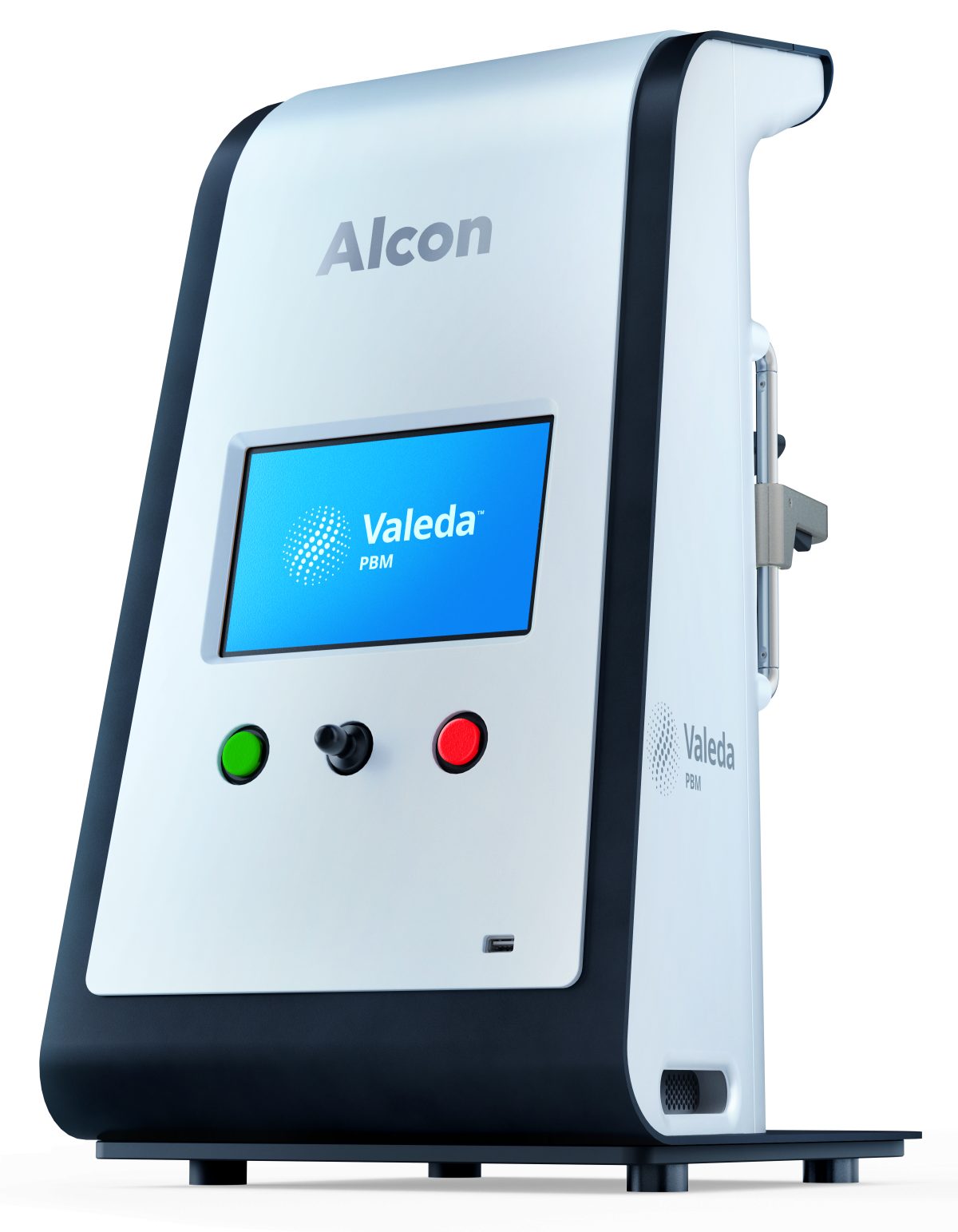
The Valeda Light Delivery System is the name people reach for when they want to know whether at-home red light eye masks measure up to “the real thing.” The short answer is that Valeda occupies a different tier: it is the only photobiomodulation eye device with FDA authorization for dry age-related macular degeneration, it is administered in a clinic, and it is backed by a pivotal trial that no home mask can claim. At-home devices deliver light in similar ranges at a fraction of the cost, but as wellness products without that trial or that supervision.
This is a clinic-versus-home comparison, not a product roundup. For the device-by-device assessment of the at-home options named here, see our eye-device buying guide. We sell no hardware and score every option on the same criteria.
What is the Valeda Light Delivery System?
Valeda, made by LumiThera, is a clinic-based photobiomodulation system that delivers three wavelengths in sequence, 590nm yellow, 660nm red, and 850nm near-infrared, in a short supervised session. It is used as a course of treatments rather than a one-off, typically a series of sessions over a few weeks that is repeated periodically.
What sets it apart is regulatory standing. In late 2024 the FDA authorized Valeda for dry age-related macular degeneration, making it the first photobiomodulation device authorized for an eye disease (FDA, 2024).
That authorization rests on the LIGHTSITE III trial, a multicenter sham-controlled study that reported improved best-corrected visual acuity in dry AMD (Boyer et al., 2024).
How Valeda compares to at-home eye masks
The core difference is evidence tied to the specific device. Valeda has a pivotal trial and an FDA authorization for a defined condition. At-home eye-health masks deliver research-supported wavelengths, but the evidence behind them is mapped from studies of the same light rather than trials of the units themselves, and they are sold as wellness devices.
The wavelengths also differ. Valeda combines 590nm, 660nm, and 850nm, while a typical at-home eye-health mask uses 670nm red and 810nm near-infrared, the ranges most studied for ocular tissue (Gaspari et al., 2024). Both sit in the red and near-infrared window thought to drive photobiomodulation, but they are not identical recipes, and Valeda’s specific combination is the one carried through its trial.
Finally, the setting differs. Valeda is delivered under clinical supervision with a protocol matched to a diagnosis, whereas home masks put dosing in the user’s hands within preset limits. That supervision is part of what the higher price buys.
Comparison: Valeda, at-home, and clinician-guided devices
| Feature | Valeda (clinic) | At-home eye-health mask | Clinician-guided home mask |
|---|---|---|---|
| Wavelengths | 590 / 660 / 850nm | 670 / 810nm | ~630nm |
| Primary target | Dry AMD | Dry eye, MGD, retinal support | Dry eye, MGD |
| Regulatory status | FDA-authorized (dry AMD) | Wellness device | CE-marked |
| Device-specific trial | Yes (LIGHTSITE III) | No | Yes, for dry eye |
| Setting | In clinic, supervised | At home, self-administered | Home, clinician-set protocol |
| Cost model | Recurring course | One-time (~$289) | One-time plus fitting |
| Access | Find a provider | Buy directly | Through a clinic |
Specifications are manufacturer- and trial-reported and approximate (early 2026).
Where Valeda wins
Valeda is the stronger choice when the condition is serious and the evidence bar matters. For dry AMD specifically, it is the only option that has cleared a pivotal trial and an FDA authorization, which is exactly the situation where you want a treatment with real clinical data behind it (Boyer et al., 2024). The clinical supervision adds another layer, because a clinician matches the protocol to your diagnosis and monitors the response, rather than leaving dose and timing to you.
Where at-home devices win
At-home masks win decisively on cost and access. They are a one-time purchase used indefinitely, with no appointments and no recurring fee, and they cover use cases Valeda does not target, such as everyday dry eye, blocked oil glands, and general retinal aging. For someone whose goal is at-home support for dry, gritty eyes rather than care for a diagnosed retinal disease, a home mask delivering 670nm and 810nm light is a reasonable and far cheaper starting point, and its wavelengths are well studied (Shinhmar et al., 2021).
The clinician-guided home masks add a middle path, pairing home convenience with a protocol a clinic sets and dry-eye data behind the device (Giannaccare et al., 2022).
Who should consider which
The decision comes down to your condition and how much the evidence bar matters to you.
- You have diagnosed dry AMD: Valeda is the option with FDA authorization and a pivotal trial. Discuss it with your retinal specialist.
- You want at-home support for dry eye or MGD: an at-home or clinician-guided eye-health mask is the practical, lower-cost route.
- You want cosmetic under-eye results: neither category fits; see our eye-mask guide for skin-focused devices.
- You are cross-shopping at-home devices: compare them head to head in our device buying guide.
Is Valeda available to me?
Valeda is not sold for home use; it is offered through eye-care practices that have adopted the system, so access depends on finding a provider near you. If you have dry AMD and want to pursue it, ask your ophthalmologist or retinal specialist whether they offer photobiomodulation or can refer you to a clinic that does. Because it is a supervised course tied to a diagnosis, it is not something to source or self-administer at home.
Frequently asked questions
Is Valeda FDA approved?
Valeda received FDA authorization for dry age-related macular degeneration in late 2024, the first photobiomodulation eye device to do so (FDA, 2024). It is authorized for that specific use, not as a general eye-wellness device.
Is Valeda better than an at-home red light mask?
For diagnosed dry AMD, Valeda has evidence and regulatory standing that no home mask matches. For everyday dry eye or general support, an at-home mask covers different ground at far lower cost. They are built for different jobs, so “better” depends on your goal.
Can I buy a Valeda device for home use?
No. Valeda is a clinic system administered under supervision as a course of sessions. If you want an at-home option, see our device buying guide for masks you can own.
What wavelengths does Valeda use?
Valeda delivers 590nm yellow, 660nm red, and 850nm near-infrared in sequence. At-home eye-health masks more commonly use 670nm and 810nm, which are also well-studied ocular ranges (Gaspari et al., 2024), but the specific combinations differ.
How much does Valeda cost compared to a home device?
Valeda is a recurring clinic cost, typically a course of sessions repeated periodically, so it totals far more than a one-time home mask of around $289. We break the numbers down in our cost and value guide.
Does at-home red light therapy work as well as Valeda for AMD?
There is no trial showing a home mask matches Valeda for dry AMD. Home devices use research-supported wavelengths but lack a device-specific pivotal trial, so for AMD specifically the evidence favors the clinic system. For a diagnosed retinal disease, work with a specialist.
The bottom line
Valeda and at-home red light eye masks are not competitors so much as different tiers for different situations. Valeda is the FDA-authorized, trial-backed, clinic-administered choice for dry AMD, and worth its higher recurring cost when the condition and the evidence bar call for it. At-home masks are the practical, one-time option for everyday dry-eye support and general use, delivering studied wavelengths without the trial or the supervision. Decide by your condition first. To compare the at-home devices in detail, see our device buying guide, and for the underlying science, our research reviews.
This guide is an educational comparison of published evidence and manufacturer data. It is not medical advice and does not create a doctor-patient relationship. Always talk to a qualified eye-care professional before starting any light-based therapy.
More from the Institute
 Emerging
Does Red Light Therapy Help Glaucoma?
Red light therapy for glaucoma is an emerging, mostly preclinical idea built on retinal-ganglion-cell neuroprotection. What the science shows, what…

Blue Light Glasses for Kids: Do They Help?
Do kids need blue light glasses? The evidence says no proven benefit. Here is what actually protects children's eyes around…
 Mixed
Mixed
Red Light Therapy for Under-Eye Bags and Dark Circles
Does red light therapy help under-eye bags and dark circles? What the evidence supports for the skin, what it cannot…